
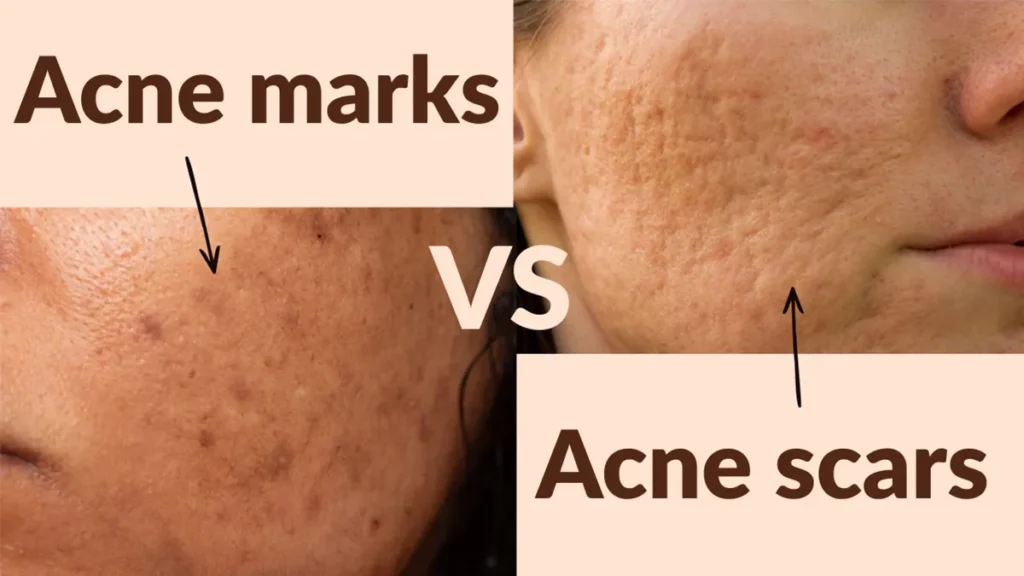
You can spend months treating a spot on your face and see no change, simply because it is not what you thought it was. Acne leaves two very different kinds of aftermath: marks, which are flat discoloration, and scars, which change the texture of your skin. They can look alike in a bathroom mirror, yet they respond to completely different approaches. Once you know which you have, choosing what to do next becomes much simpler.
The quick answer
If the spot is flat and only differs in color, it is a mark, and marks usually fade with time, sunscreen and the right ingredients. If it is indented, raised or rough to the touch, it is a scar, and it will not disappear with creams. Many people have both.
What acne marks are
Marks are technically called post-inflammatory discoloration. After a breakout heals, your skin sometimes leaves a patch of color behind. Nothing has changed in the skin’s structure, which is why marks can fade completely.
Red or pink marks
These come from irritated or widened blood vessels after inflammation. They tend to be more visible on lighter skin and often fade over several weeks to a few months.
Brown or tan marks
These come from extra pigment. They are more common on medium to deeper skin tones, and they last longer, sometimes six months or more, especially if the skin is exposed to the sun. See our dark spots guide for more on how pigment works.
What acne scars are
Scars form when a breakout damages the skin deeper down and the repair process leaves a change in texture. They are permanent without professional treatment, although many can be improved.
- Ice-pick scars: narrow, deep, pit-like marks.
- Boxcar scars: wider depressions with defined edges.
- Rolling scars: shallow, wave-like dips.
- Raised scars: thick, firm marks that rise above the surface, more common on the chest, back and jawline.
The fingertip test
Wash your face, pat dry and look in natural light. Then gently run a fingertip over the spot. If you feel nothing but see color, it is a mark. If you feel a dip or a bump, it is a scar. Stretch the skin gently: if the spot becomes less visible when the skin is pulled flat, it is likely a rolling scar rather than a mark.
What helps marks at home
Sunscreen, every morning
This matters more than any serum. Sun exposure darkens marks and makes them last longer. Use a broad-spectrum SPF daily, even on cloudy days.
Niacinamide and alpha arbutin
These ingredients support a more even-looking tone. Our Dark Spot Correcting Serum combines both. Read the guides to niacinamide and alpha arbutin.
Vitamin C
A brightening antioxidant that can help dull, marked skin look fresher. The Double Vitamin C Serum pairs it with hyaluronic acid.
A weekly mask
If you want an extra boost, a turmeric sheet mask adds turmeric, honey, niacinamide and alpha arbutin once or twice a week.
Patience and consistency
Marks fade gradually. Take a photo every two weeks in the same light, and give any new routine at least eight weeks before judging.
Professional options for scars
Scars need treatment that changes the skin’s structure. A dermatologist may recommend one or a combination of the following:
- Microneedling: tiny punctures that prompt the skin to rebuild collagen.
- Chemical peels: controlled exfoliation, better for shallow scars.
- Laser treatments: several types, chosen by scar type and skin tone.
- Subcision, fillers or surgical options: for deeper or tethered scars.
Results vary, usually take several sessions and are not guaranteed. Choose a qualified dermatologist and ask about your skin tone, as some treatments carry a higher risk of pigmentation on deeper skin tones.
If you have marks and scars
Treat the color first. Fading marks can make scars look less obvious, and a clear idea of what remains helps you decide whether professional treatment is worth it.
Not sure which serum fits your marks?
For brown marks and uneven tone, begin with the Dark Spot Correcting Serum. If your skin also looks dull, the Double Vitamin C Serum adds brightness. Compare both on our face serums page, or message us and we will help you choose. Orders ship worldwide with DHL, free above $99.
A simple routine to start
- Morning: gentle cleanser, vitamin C serum, moisturizer, sunscreen.
- Evening: gentle cleanser, niacinamide or dark spot serum, moisturizer.
- Once or twice a week: a sheet mask in place of the evening serum.
- Always: avoid picking and introduce one new product at a time.
Questions people ask
How long do acne marks take to fade?
Red or pink marks often fade over a few months. Brown marks can take longer, sometimes six to twelve months, and they fade faster when you wear sunscreen every day.
Can a serum remove acne scars?
No. Serums can help with color, but scars are changes in the texture of skin. Treatments such as microneedling, peels or lasers, done by a professional, are the usual route.
Is niacinamide good for acne marks?
Niacinamide supports an even-looking tone and is a popular choice for post-acne marks. It works gradually, so use it daily for several weeks.
Can I use vitamin C and niacinamide together?
Many people use vitamin C in the morning and niacinamide in the evening. If your skin tingles or turns red, use them on separate days.
Does sunscreen really matter for marks?
Yes. Sun exposure darkens brown marks and slows their fading, so sunscreen is the single most useful step.
Should I pick or squeeze spots?
No. Picking increases inflammation and is a common reason marks and scars form.
When should I see a dermatologist?
If you have deep, painful, cystic acne, if scars are forming, or if marks do not improve after a few months of consistent care.